Showing posts with label contradiction. Show all posts

Is God Love?

When I was a child, I was raised to believe that God and Jesus loved me, but that I was a terrible sinner. I was told over and over that Jesus had to die for me, and that I had to accept him into my heart and then be baptized if I wanted to avoid eternal hellfire and damnation. I was baptized three times in three different churches because I was so terrified of eternal torment.

In the past year I have talked to Christians and Catholics who have a very different experience of God than I did. If I mention the hellfire and brimstone preaching of my childhood they tell me how different it really is. They all say the same thing. God Is Love.

Last year my local atheist group (Morgantown Atheists) went to a megachurch together to experience it. While the preacher didn't say God Is Love, the message was very clear. In fact the first emcee guy even said he was there to make our experience as pleasant and comfortable as possible. There was mention of Jesus dying for our sins, and that we needed him, but no mention of hell, no mention of anything negative. It was all very wishy-washy and watered down, all very pleasant and positive.

I would guess that both kinds of churches still exist today. I'm sure southern baptist and maybe pentecostal are more about hellfire and brimstone, putting the Fear of God into people to keep them on the straight and narrow. Maybe the fundamentalist churches too, but that's a guess.

I wonder which kind of message is more prevalent today? (I know some of you Google-mad geeks can help me come up with the perfect terms to search here!) I have a feeling it's the feel-good God Is Love message. It's certainly very pleasant and seems to embrace more people and accept them. But I am definitely an outsider on this so I am not sure.

Please feel free to share your church experiences: Which churches have you been to? What was the fundamental message? God is Love? or Fear God? Or some weird twisted combo package? Or something else entirely?

But is God Love? I've read the bible more than once. The god of the old testament is most definitely an angry, jealous god. He says so himself. In fact even his name is Jealous. (Exodus 34:14)

God Is Either Evil Or Incompetent... Or Nonexistent

I was trying to explain to someone recently about the "Why Won't God Heal Amputees" argument. For privacy's sake, I won't talk about what she said, but I did end up with the following questions and arguments of my own.

This is one of those topics where atheists and believers are never going to be in the same book, never mind on the same page. Here is what I think about it.

God answers prayers every day for football players catching touchdown passes, for people finding their keys, for people being miraculously healed of cancer, for people spontaneously being cured of diseases who go to Lourdes. Mary and Jesus show themselves in toast, stains on walls, in bird poop, in window glass streaks. Every day, miracles happen.

But they are only ever events that could happen statistically. They never break the laws of physics, they never break the natural laws of the universe. Sure, it's very rare for someone to have a spontaneous remission in their cancer. But it does happen. It's improbable, not impossible. So it will happen in time.

But God never performs a miracle that is impossible. It's impossible for a limb to regrow on a human. But lizards do it all the time. Why would God let lizards regrow a tail and not some poor girl who had her leg cut off in a tribal war? Or because she was called a witch in Ghana? Or why can't a war hero, if he and his whole family pray hard enough, let him grow his arm back that he lost defending his country?

God is omnipotent, omniscient and all loving. But I've heard from christians many times that God follows his own rules. But why? He's God. Why doesn't he ever answer any really tough prayers? Why only the easy ones and the ones that are statistically improbable but not impossible? Why doesn't he ever cure someone who has prayed fervently to be cured of something like AIDs or cerebral palsy? Because that's impossible.

The Afterlife and Sentient Rocks

Last night our local group of heathens and extended friends had our Winter Solstice/Festivus/FSM Holiday/Christmas/Hanukkah party. It was fun. The conversation was very interesting and incredibly diverse. Here are two topics I discussed.

I was talking to a Buddhist physicist who works for NASA part time. He started talking about how the earth and rocks have sentience. I disagreed, of course. He had this weird logic that was completely flawed. He said something about how humans are sentient, and we need the sun and the earth so they are sentient too. Um, what? And he works for NASA?

My friend Eric works for NASA. He went to his office christmas party where they prayed at the beginning "in jesus name".

This is fascinating and disturbing. I had this idea that people in places like NASA are rational and critical thinkers. But I guess you can be smart in one area and compartmentalize your beliefs and faith in the supernatural in another, and blithely eschew critical thinking. I think early and lifelong indoctrination is definitely a factor. It is disheartening, though.

~

One of my friends, Jim, is a grief counselor so he and I ended up talking about death and the afterlife. Cheery, huh?

We both agreed that as atheists, there is no fear of death. Being dead is natural. It's the end. For about 14 billion years before you were born you didn't exist. Now you do. Eventually (hopefully later rather than sooner, after a rewarding and wonderful life) you will die. We all die.

Where I have problems with death is the actual act of dying. I really don't want to suffer. I don't like pain. I don't want to lose all of my dignity. As Jim said, though, we are really working on that.

Anyway, if you're religious, you are led to believe that there is an afterlife. Well, some religions anyway. Apparently the jews don't hold to that notion. So if you're a muslim and you do good deeds like kill a bunch of innocent infidels you and 72 members of your family go to heaven where you get 72 virgins (see inside label for details).

If you're a christian, you get two choices (well, catholics get purgatory, too). You're going to hell unless you get saved and accept jesus as your savior (rules and restrictions may differ for your denomination. See insert). Then you get to go to heaven to worship god for all eternity.

Neil C. Reinhardt Shows His True Colors

When someone sends me spam, I figure the information sent to me is fair game. Remember the guy who sent me the email about noni juice? I blogged about it twice: (here and here).

In the second post, I went through his email line by line and stated the logical fallacy. I made no personal attacks (except one, I'm only human after all). When I published the post, I removed his name. I wasn't trying to attack the spammer personally. I just thought it was an excellent exercise for us.

What I didn't do, is write back to the guy. As I said, it seemed like spam, and I didn't want to get into it with him. I figured I'd never hear from him again. I heard from him 5 times this evening. Oh, lucky me, I just got another one from him. That makes 6.

When he sent the first ones, he apparently hadn't seen the articles. In the first email of the evening he wrote:

"P.S. FYI The odds of you ever knowing, and/or ever meeting, anyone who is MORE truthful than I am is zero!"

To which I replied, "In my experience when someone starts out saying how [insert noble quality such as honesty, fidelity, etc. here] they usually prove to be either self-delusional or outright liars."

He didn't like that. He said later that my experience was limited. Which I have to say, he's right. My data pool is not immense. But it's a good rule of thumb in my experience. When someone tells me, "I'm so honest, I'm so faithful, I never lie, I'll always do this behavior" I will remember that. It's usually a huge red flag that they will fail in that exact respect sooner rather than later.

I'm not a psychologist but it seems to me that that there are two things going on. Either you're lying to yourself when you say such a thing, or you're lying to whoever you say it to. Or some combination thereof.

Anyway, I started to reply to this guy's email. I wanted to make it very clear that I didn't want his juice and I didn't want to argue with him. The way he talked about James Randi was another red flag I should have heeded.

He sent a long email of glowing reviews from other people. (I gather he is on a forum or something). This is anecdotal and irrelevant to me.

Another email was vague and I have no idea what it was about.

Then the kicker. Obviously he visited HDC. If you don't want to read strong language, skip this. It's exactly as he sent it in its entirety. Notice I do not do the courtesy of removing his name this time:

Proof Against God

The following is an article by GMNightmare which follows up from a previous post titled Your god is Not Omnipotent:

To start out, the definition I am using for god is any given being that can supposedly create matter out of nothing, is omnipotent, and is unbound by physical spatial traits. Furthermore I derive that an omnipotent god constitutes as an unstoppable force or can be the causation of such. The existence of such a god forms my hypothesis (which I will regard as true for this proof); therefore the following mainly concerns itself with monotheistic brands of gods.

Using the above traits, the god from my hypothesis could create an object of infinite size and maximum density. This theoretical object would literally fill the entirety of the universe, with every small speck of space filled with matter. This rock constitutes as an immovable object as there is nowhere left to move the rock and thus it is incapable of movement. As an aside it happens that god can create an object so large that he cannot move it.

However the existence of an immovable object by definition means that an unstoppable force cannot also exist. Since that is a part of the definition of god outlined above, I therefore must reject the hypothesis and assert that such a god cannot and does not exist. In particular a god that can create matter unrestrained cannot also be omnipotent in all regards.

Simple, short, and sweet… but the devil is in the details (ha ha). Any god with boundaries and limitations obviously escapes the above, but from my experience that’s the last thing any monotheist will even begin to contemplate (god being the biggest baddest supernatural being that ever was—who also happened to create everything—just isn’t enough, seemingly god must also have limitless power and ability). So please qualify objections to the below considerations.

1)      Can god create an object so large even he cannot move it?

Pure Atheism vs Skeptical Atheism

Quite some time ago I noticed that all atheists do not approach nonbelief the same. I, for one, was first a doubter, then an agnostic, then an atheist who still believed in woo, then a full on skeptic and atheist. One of my new friends on Facebook, Cursus Walker, put it clearly the other day in a strange conversation a bunch of atheists had in a new group I joined called People for the Ethical Treatment of Atheists. (lol!)

Cursus Walker said, "I make a distinction between Pure and Skeptical Atheism. The former refers only to lacking belief in gods, while the latter extends the attitude to all supernaturalism."

I couldn't agree more! I like the terms and thought I'd share them with you.

Pure Atheism: A lack of belief in gods.

Skeptical Atheism: A lack of belief in all things supernatural.

As a skeptical atheist, I have trouble understanding how people can believe in ghosts, ESP, life after death, or anything along those lines, while not believing in any gods. So the concepts aren't mutually exclusive. But it still amazes me to run into atheists who use no skepticism or logical reasoning when it comes to supernatural woo. Can't you just feel the cognitive dissonance?

And why do you think that is? Is it a need for comfort? Is it fear of the unknown and death? Is it ignorance in science and the laws of nature? All of the above? Probably.

Of course, as synchronicity would have it, I stumbled upon a QualiaSoup video (thanks to my awesome husband) shortly after and it was so good I have to share it with you here. It's kind of relevant, but excellent in its own right. About 10 minutes long.

Putting Faith in its Place

A Thought Experiment With Your Religious Friends

I am reading several books right now (I have them all listed in the left sidebar). One is called The God Virus and I just started it the other day. On page 18, Darrel W. Ray describes an experiment. I think I've heard of it before, but I thought I'd share it with you because it shows how religion attacks the critical thinking skills of the mind. As Mr. Ray says, it leaves the skill intact for other religions but disables critical thinking about one's own religion. It really is like a virus of the mind.

Here's the experiment as explained in the book:
You have a serious conversation with a deeply christian friend. Your friend is intelligent, well educated and knowledgeable. You agree to record the session. The topic is islam. During the session, you discuss that mohammed was a self-appointed prophet and that he claimed he talked to allah and the angels. He wrote a book that he claimed was infallible, and he flew from Jerusalem to heaven on a horse.

During the conversation, you agree that mohammed was probably delusional to think he could talk to god. You agree that the koran was clearly written by mohammed and not allah. It is ludicrous for him to claim that he is the last prophet and that all others are false. Neither you nor your friend can believe that he flew to heaven, let alone on a horse. It all sounds too crazy, and you both agree it is difficult to see how someone could believe such a religion. At the end of the conversation, you say that muslims did not choose their religion; they were born into it. Anyone who was exposed to both christianity and islam would see that christianity is the true religion.

It's About Time That The Religious Are No Longer A Protected Class

The following is a question asked of Daniel Dennett, and his answer which was in the Washington Post the other day. My comments are below.


Q: Is there widespread media bias against Christianity? Against evangelicals such as Brit Hume and Sarah Palin? Against public figures who speak openly and directly about their faith? Against people who believe as you do?

There is no media bias against Christianity. If it appears to some people that there is, it is probably because after decades of hyper-diplomacy and a generally accepted mutual understanding that religion was not to be criticized, we have finally begun breaking through that taboo and are beginning to see candid discussions of the varieties of religious folly in American life. Activities that would be condemned by all if they were not cloaked in the protective mantle of religion are beginning to be subjected to proper scrutiny.

There is still a lot to accomplish however. We need to change the prevailing assumptions in the same way that public opinion has been reversed on drunk driving. When I was young, drunk drivers tended to be excused because, after all, they were drunk! Today, happily, we hold them doubly culpable for any misdeeds they commit while under the influence.

Many Americans Are Religiously Mixed Up

Wha?The Pew Forum on Religion and Public Life just released a new survey today. I've given it a quick persusal and I have to say, while some of it is interesting, most of it doesn't surprise me. Apparently large numbers of Americans engage in multiple religious practices. Stuff you'd think would cancel each other out, but they handle the cognitive dissonance without hesitation.

For example, many blend christianity with Eastern or new age philosophies such as reincarnation, astrology and the belief in spiritual energy in physical objects. Sizeable minorities in all major U.S. religious groups say they have experienced supernatural phenomena, such as being in touch with the dead or with ghosts.

A third of Americans attend different religious services. Personally I find this amazing. When I studied different religions, I lost my faith in all of them pretty quickly because they sort of canceled each other out. Instead 35% of Americans seem to handle the conflicting faiths and stories just fine.

24% of Americans and 22% of christians, specifically, believe in astrology and 15% have consulted a fortuneteller or psychic. Damn, I'm in the wrong business.

Nearly half (49%) of the public says they've had a religious or mystical experience, defined as a "moment of sudden religious insight or awakening."

This is interesting but not surprising. About 1/4 of adults express belief in tenets of certain Eastern religions: 24% believe in reincarnation, 23% believe in yoga as a spiritual practice. 26% believe in spiritual energy located in physical things such as mountains, trees or crystals and 25% believe in astrology. About 16% believe in the 'evil eye' or that certain people can curse or cast spells that cause bad things to happen to someone.

Objective Versus Subjective


I'm seeing this video being repeatedly posted on Facebook as it chains its way though the theist world. From what I've gathered from the YouTube mirroring, this is a TV commercial running in the Republic of Macedonia. The campaign is apparently something like "Knowledge Is Power." And this part of the campaign is apparently sub-headlined "Religion is knowledge, too. Bringing religion back to school."

Justifying Our False Beliefs

I think I'm beginning to understand something about believing. Over the years I've encountered many religious people who have tried to explain to me why I need to believe as they do, why they are right and I am a fool for not understanding that. But I don't have faith like they do. Hell, I don't want it. Faith, by definition is belief that is not based on proof.

I embrace reason and a desire to understand the universe. While we certainly don't have all of the answers, that doesn't mean we stop asking questions. There is always something interesting to learn about.

I love asking questions. One that has puzzled me in the last year or so is why people cling to false beliefs so strongly. No matter how much I reason with a True Believer TM or try to educate them with facts, they just dig in their heels, sit on their haunches and bray their myths and lies over and over. They block their ears, squint their eyes shut and cry out, "I can't hear you, I won't listen… lalalalalalalalala…."

Yesterday I found a new study on ScienceDaily titled "There Must Be a Reason: Osama, Saddam and Inferred Justification". It was published in the most recent issue of Sociological Inquiry. It's a study by four research institutions to understand why people kept believing that Saddam was involved in the 9/11 terrorist attacks even once it was obvious that there was no evidence supporting that claim.

But that's not why I was so fascinated. What caught my attention was the underlying research about false beliefs.
Some people form and cling to false beliefs despite overwhelming evidence thanks to a mental phenomenon called motivated reasoning, says sociologist Steven Hoffman, visiting assistant professor at the University at Buffalo and co-author of the study. "Rather than search rationally for information that either confirms or disconfirms a particular belief, people actually seek out information that confirms what they already believe. For the most part," says Hoffman, "people completely ignore contrary information" and are able to "develop elaborate rationalizations based on faulty information." (Newsweek)

Now, let's think about the belief in a god that created the world in 6 days about 6,000 to 10,000 years ago, shall we? And of course, Jesus who died on the cross to save us all from hellfire and damnation. So let's talk a bit about motivated reasoning:

The Resurrection Never Happened

JesusCatResurrectionNeece posted on the Codex Sinaiticus a few weeks ago. I've been digging around, reading it (a little) and about it, and was formulating a reply to add to her article. After a bit of writing, I decided I should just make it a separate article.

Let me start with a little background information. Many Christians mistakenly assume that the four gospels (Matthew, Mark, Luke, & John) are independent accounts of the life of Jesus. Thus they assume that four corroborated eyewitnesses prove his existence, and the validity of every story told of him. Several facts knock this premise on its ear; but somehow Christians hold fast to their belief still.

First, Luke starts his book by stating that he is drawing up accounts "as they were handed down to us by those who from the first were eyewitnesses" (in case that is too cryptic, he is admitting these were the stories told to him; that he was not an eyewitness). Second, we have historical and archeological information that indicates the new testament books were written after 45 CE at the earliest; most were after 90 CE. Third, we have in depth analysis and research that has resulted in plenty of proof that three of the four copy from another. Yet still many Christians think them all perfect accounts of the life of Jesus. Even his existence cannot be proven absolutely.

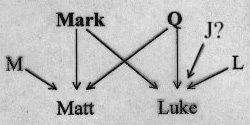
Most scholars agree that Mark was written first, and the other three had a copy or version of Mark they built their work from. The most common hypothesis currently is that Matthew used Mark or a version of Mark (M) in conjunction with the Q document (an as-yet undiscovered document). Luke used Mark and the Q document; as well as at least one other source (L), possibly two (J). The gospel of John came last, in addition to being very obviously written by a Greek (when original versions are examined). "The Gospel [of John] certainly does not appear to have been written by an uneducated fisherman from Galilee, which is who John the disciple is portrayed as in Gospel stories." John appears to use Matthew, Mark, and Luke; but takes many liberties by using "eloquent Greek prose for the speeches of Jesus" instead of just translating. [SOURCE]

Most of you probably knew this, or knew of it in general, so I'll get on with the "new" information.

Conversations With christians - Beth 2 - Down The Rabbit Hole

funny-pictures-your-cat-should-be-doused-in-holy-waterHello everyone. I heard from Beth again today and will share our further exchange with you in a minute. After I posted the first conversation with her, she and I corresponded at least once more that night. So the following exchange is actually a few emails back and forth. I hope I can keep it straight for you so that it all makes sense.

I have to say, talking to christians is no easy task. I'm sure you understand that in your own experience. It's almost crazy-making to try to reason with someone who believes that Jesus raised the dead and walked on water. I don't know how people who debate such things don't lose their tempers and start smashing things. I guess I understand why some atheists are considered angry. They're probably just frustrated, like I am.

Anyway, here we go. We'll start with Beth. My comments will follow hers.
I apologize because I failed to inform you that even though I am Christian, I do not think the Bible is without flaws. It was written and edited by man, who is imperfect by nature, and therefore I leave room for error in it. When I stated I agree with Jesus's teachings, it was not my intention to come across as the type to "cherry pick", but to establish, given my ideals, that I view Jesus as a figure who represents righteousness. For example, it is like reading a fictional story. You see it is not true, but you can pick up on the lessons and agree with them. Now arguably, that is not sufficient enough a comparison since the foundation of my faith is the Holy Book, but I am not religious. I am spiritual. Organized religion, from my stance, is corrupt to a degree. Mind you, it does not take away from what Jesus advocated. People tend to misinterpret what he said and judge others based on their standards. My definition of what it constitutes to be a Christian appears to be different from yours. I do not fault you for that. I cannot explain myself well on that point, but trust me, I can still give myself that title even if there seems to be contradictions with how the church labels it and how I do. (if you insist on me elaborating on that then I will do my best)

I think I understand. You are a christian, a follower of christ. Spiritual but not religious. I get it. I wonder what being a christian means to you, but don’t feel pressured to explain it to me unless you want to. I already know what the church says. But how you see yourself and how you see christ is interesting to me.
Now, to address the "Is Jesus real?" question. Yes, I do think he lived. I see the parallels between him and other Gods invented (if you prefer that term) before him, but it does not change the fact he was there. Now I'm quite certain you could pull out a list of documents that show otherwise and I would not deny they demonstrate how he possibly couldn't have existed. However, I can also see evidence of him existing being destroyed as a result of how not many agreed with Christianity at the time and would not want a record of him around. I do believe him to be the Savior so yes, I believe he performed those miracles, even if science cannot completely fathom how such was possible. That goes into my belief that God is omnipotent and what that entails.

Do People Need To Worship? EDITED

Farrah_Fawcett_iconic_pinup_1976This is not about church so much as society and culture. Recently Farrah Fawcett died. Later in the day Michael Jackson bit the dust as well. The world seemed to forget about Farrah immediately and focus on Jacko and how much of an amazing person he was.

Do people have such short attention spans and memories? Do they so easily forget what a freak he was? Do they so mindlessly get selectively nostalgic when someone dies or a big event happens?

I am so over Jacko, not that he was ever big on my list. He was a pedophile and a full-on freak. Why is he being revered? Has the catholic church's silent acceptance of pedophilia made most people numb to such horrors when committed by the exceedingly rich? I question the cognitive processes of anyone who feels the need to worship at the feet of such sickness.

On the other hand, Farrah died at age 62 of cancer. She was a good person who actually contributed to our entertainment. When she made The Burning Bed in 1984 (which was based on a true story), she was forever changed by that experience. Not to mention, as a sex symbol, she was willing to make that movie in the first place.

I found out a few minutes ago that she left donations to shelters for abused women, as well as some of her belongings. That's wonderful and thoughtful.

Alien-vs-PredatorBut it's not as interesting, apparently, as Jacko, who slept in a hyperbaric chamber, drank "jesus juice",  was a jehovah's witness and liked to diddle little boys then pay their families off for the privilege. So the world weeps for him? That's disgusting. Why would anyone feel the need to worship such a horrid person?

Then again, why do people worship god in whatever barbaric religion he is in? Do most people need to worship and look up to someone or something above them? Is it some vestige of evolution that we have yet to shed?

EDIT: My most awesomest husband Butch has written an excellent article about Whacko Jacko, along with an exclusive photo of said molester holding some damning evidence.

Also, here are some Smoking Gun articles that may interest you:

Jackson the Predator

Jackson's Legacy (with transcript)

Oh Jesus!

I find your lack of faith disturbingI was having a conversation with my friend Steve earlier about Jesus. Was there a Jewish rabbi named Yeshua walking around the Fertile Crescent around 2000 years ago, preaching the end of days? Does it matter? This is my conclusion. No, not really. We'll never know the truth of it, and it doesn't matter anyway.

Steve says the majority of scholars feel that there was such a guy. I've been under the impression for many years that the biblical Jesus never existed. But I think it's just an exercise in scholarship and semantics, really.

Here's where I started:

  • Josephus was the nearest contemporary to Jesus, and he never met him.

  • All the gospels were written 40-80 years after the supposed crucifixion. None of the gospel writers or Paul/Saul ever met Jesus.

  • The Romans were meticulous record keepers back then. Not a word of the uppity Jew named Yeshua/Jesus whom they had to crucify.

  • Never a word of the miracles in Roman record keeping either.


Here is what he said:

Delusional Optimism: We All Need A Refreshing Dose Of Reality

funny-pictures-cat-is-wearing-a-grumpAmerica has bought into the concept of Self-Esteem = Success. Every pop psychology self-help book touts the same fluffy nonsense: change your mind and it will change your life for the better. Think positively and you can succeed at anything you put your mind to. Unfortunately it's unfounded and unscientific.

This morning my friend Tim linked me to an article titled Positively Misguided: The Myths & Mistakes of the Positive Thinking Movement. It's well worth the read. In January, I wrote about something similar: The Law of Attraction- and the Secret- Are Bullshit. Well, we can see who's more highbrow. :P  But it comes down to the fact that having high self-esteem and a delusional positive mental attitude is not helpful. The article is a bit long, so I'm going to paraphrase it for those of you with a short attention span:

Cherry-Picking and A bible Lesson For Atheists

realityI was stumbling around the intertoobs and found a blog post at dmiessler titled The Jesus Quote You'll Never Hear In Church. The quote is as follows:
Luke 19:27 But those mine enemies, which would not that I should reign over them, bring hither, and slay them before me.

Now, this is actually the end of the parable of the talents that jesus is telling. Basically the lesson that jesus seems to imply is that god takes what is not rightly his and reaps what he didn't sow. Of course, jesus freely admits that he tells parables to confuse people so they will go to hell:
Mark 4:10-12 And when he was alone, they that were about him with the twelve asked of him the parable.
And he said unto them, Unto you it is given to know the mystery of the kingdom of God: but unto them that are without, all these things are done in parables:
That seeing they may see, and not perceive; and hearing they may hear, and not understand; lest at any time they should be converted, and their sins should be forgiven them.

Not very nice, is it? Then again the bible is full of amoral cruelty and malice. Most people talk about the old testament, which is rife with stories of god slaughtering and maiming just about everything because he's so angry and jealous. But the new testament is full of nastiness as well. The Skeptic's Annotated Bible has compiled a nice list to make it easy: Cruelty In The New Testament, so I won't go over each one.

Anyway, regarding the first quote above from the book of Luke, christians will retort that it was a parable, not a quote. But right after the story, he tells his disciples to go steal a colt so that he can ride it into Jerusalem (Luke 19:30). So if he's willing to have his disciples steal for him and take what wasn't his, it really isn't out of context, now is it?

I really must point out one other new testament quote by jesus, because it shows that he is just as petty and cruel as his dad:
Luke 14:26, 33 If any man come to me, and hate not his father, and mother, and wife, and children, and brethren, and sisters, yea, and his own life also, he cannot be my disciple.
So likewise, whosoever he be of you that forsaketh not all that he hath, he cannot be my disciple.

What kind of kindly, peace-loving godlike person would say such a stupid thing? Then again, just read all the heinous things that god did in the old testament to see that the apple didn't fall far from the tree.

Anyway, this all reminded me about cherry-picking, which is a logical fallacy. I've found that it's quite natural for people to cherry-pick information to suit their needs. You remember the bad times with your ex and happen to forget how many happy times you had together. Or, the most famous and irritating of all, christians take the bible and filter out the parts that support whatever message they are trying to find there and simply ignore the rest. When you call them on it, they say you have to take the icky bits in context, because then they show that they really aren't amoral and cruel or malicious, just misunderstood.

Updates: A New Study and Obama's Faith Council

nursing der own doom.A couple weeks ago, I wrote about Sheeple: Studies About Social Conformity. I focused on 3 studies that show how people are easily influenced and manipulated, mostly by the authority figures in their lives. The other day a new study was published that added to this and I wanted to share it with you.

Financial Advice Causes "Off-loading" In The Brain shows that expert advice may shut down areas of the brain responsible for decision making processes, particularly when individuals are trying to evaluate a situation where risk is involved. This study focused on financial advice given by an "expert" to participants in an fMRI machine who were told to make a decision on how to spend money. I have a feeling that this is also the case in other areas of decision making as well. Hopefully it will be investigated and tested.

It makes sense though, when you look at how easily people are led by those in positions of authority. If someone is an "expert" this study shows that the brain offloads the decision making process. It trusts the expert and gives up responsibility for that choice.
"This study indicates that the brain relinquishes responsibility when a trusted authority provides expertise, says Berns, the study's lead researcher. "The problem with this tendency is that it can work to a person's detriment if the trusted source turns out to be incompetent or corrupt."

Interesting Study Regarding Cancer Treatment For Religious

schiavo protestNo one wants to get cancer. If someone gets it, how do they handle treatment? How do they face their own imminent death?

A recent study about End of Life Care (EOL) for people with terminal cancer produced some interesting results that I had to share with you.
Link Between Religious Coping And Aggressive Treatment In Terminally Ill Cancer Patients

"Recent research has shown that religion and spirituality are major sources of comfort and support for patients confronting advanced disease. We focused specifically on positive religious coping, on people who rely on their faith to handle the stresses of serious illness and approaching death. Our findings indicate that patients who turn to religion to cope in times of crisis, such as when facing death, are more likely to receive aggressive care when they die."

The study involved 345 advanced cancer patients at seven hospital and cancer centers around the country.

An analysis of the data showed that patients identified as positive religious copers had nearly three times the odds of receiving life-prolonging care, in the form of being on a ventilator or receiving cardiopulmonary resuscitation, in the final week of life. Even after researchers accounted for the influence of important factors such as age, ethnicity, or other coping techniques, the connection between religious coping and aggressive EOL care held up.

The researchers also found that religious copers in the study were less likely to have completed advance medical directives, such as a living will or do-not-resuscitate order, which can limit the extent of such interventions in advance. The effects of religious coping on the use of intensive medical care in the last week of life remained significant even after adjusting for differences in advance care planning.

Wow. So, if you're deeply religious, you go to great lengths, even if it reduces the quality of your remaining hours and days, just to stay alive. How bizarre. Shouldn't you be happy and eager to die and be on your way to heaven? Why cling to life in your hospital bed, tied up to tubes and machines, just to be not dead for another week?

How Do You Reconcile Belief and Rationality - A Survey

Yesterday I wrote about how different atheists got their stripes, how we all came to the top of the religious mountain by our own path, and how we still all think differently and rationalize in our own ways. I created a survey of 6 questions to start a conversation about this topic. You can take the survey here, or over where I made it at Quibblo. It shouldn't take too long. I really value your input. Comments are also welcome, of course! :)


I tried to add a question about superstition but I ran out of time. So feel free to comment on if you're superstitious or not, and/or atheist/religious! Thanks muchly!

Click more for the results: